
What Is the CDC’s Role in Temperature Compliance?
The Centers for Disease Control and Prevention (CDC) is the nation’s public health agency, responsible for tracking, investigating, and publishing guidance on the prevention of disease, including foodborne illness. While the CDC does not issue regulations that directly govern businesses the way the FDA does, its role in temperature compliance is significant and two-fold.
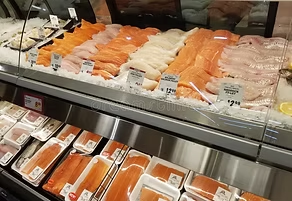
In Food Service
CDC surveillance data drives the standards that FDA, USDA, and local health departments enforce. When the CDC identifies temperature abuse as a leading contributing factor in foodborne illness outbreaks, that data becomes the scientific foundation behind the inspection criteria your business is held to.
CDC food service guidance ↓
In Healthcare
The CDC publishes the Vaccine Storage and Handling Toolkit, a detailed guidance document that defines best practices for cold storage of vaccines and is treated as the authoritative standard by health departments and the Vaccines for Children (VFC) program nationwide.
CDC vaccine guidance ↓Understanding where the CDC fits — and what it expects — matters whether you’re running a restaurant, managing a school cafeteria, operating a pharmacy, or administering a vaccine program.
CDC Guidance: Food Service & Foodborne Illness Prevention
According to CDC surveillance data, approximately 48 million Americans experience foodborne illness every year, resulting in 128,000 hospitalizations and 3,000 deaths. Temperature abuse is consistently identified as one of the leading contributing factors.
Americans experience foodborne illness each year (CDC surveillance data)
Hospitalizations annually from foodborne illness
Deaths annually — with temperature abuse a leading contributing factor
The CDC has identified two primary temperature-related failure modes that lead to outbreak events in food service environments:
- Allowing foods to remain out of temperature control for prolonged periods during service or display, enabling pathogenic bacteria to multiply to dangerous levels
- Improper cooling — failing to move hot foods through the danger zone quickly enough during refrigeration
While the CDC itself does not audit restaurants, its data and guidance directly inform what local health inspectors look for. Inspectors increasingly expect to see:
- Documented evidence that cold storage units are maintaining safe temperatures consistently, not just at the time of the visit
- Proof that temperature excursions were detected promptly and that corrective actions were taken and recorded
- Systems that remove human error and the risk of missed or falsified manual readings
How Cooler Alert Addresses CDC Food Safety Standards
- Continuous managed temperature monitoring tracks storage unit conditions around the clock, with no reliance on staff availability or manual checks
- Instant out-of-range alerts via SMS and email notify responsible staff immediately when storage temperatures deviate, enabling rapid response before product is compromised
- Multi-year record retention of all temperature data provides the documented history health inspectors expect to review
- Remote visibility lets managers and compliance officers review storage conditions from any device at any time, without opening the unit and disturbing the environment
- Multi-unit dashboard provides a single view across all coolers and freezers in a facility, with clear visual indicators for any unit requiring attention
CDC Guidance: Vaccine Storage & Handling
For healthcare facilities, pharmacies, and any organization participating in the Vaccines for Children (VFC) program, the CDC’s Vaccine Storage and Handling Toolkit establishes clear and specific temperature monitoring requirements.
CDC Vaccine Storage Temperature Requirements
- Refrigerated vaccines: 36°F to 46°F (2°C to 8°C), with an optimal target of 38°F to 44.7°F
- Frozen vaccines: -58°F to 5°F (-50°C to -15°C)
- mRNA vaccines (such as certain COVID-19 formulations): ultra-cold storage between -112°F and -75°F
- Records must be maintained for a minimum of three years
- Monitoring data must be available and reviewable without opening the storage unit

The CDC recommends continuous electronic monitoring that provides an immediate alert for any excursion outside the acceptable range — not periodic manual checks. Vaccines are sensitive biological products, and even brief temperature deviations can compromise their efficacy without any visible indication.
How Cooler Alert Supports CDC Vaccine Storage Compliance
- Continuous managed temperature monitoring tracks storage unit conditions around the clock, with no reliance on staff availability or manual checks
- Instant out-of-range alerts via SMS and email notify responsible staff immediately when vaccine storage temperatures deviate, enabling rapid response before product viability is compromised
- Three-year record retention of all temperature data satisfies the CDC’s documentation requirements for VFC providers and healthcare facilities
- Remote visibility allows administrators and compliance officers to review storage conditions from any device at any time, without opening the unit and disturbing the storage environment
- Multi-unit dashboard provides a single view across all vaccine refrigerators and freezers in a facility, with clear visual indicators for any unit requiring attention
The CDC Applies To:
CDC temperature guidance is relevant to a broad range of organizations:
Food Service
- Restaurants, quick-service operations, and catering companies
- School nutrition programs and institutional food service
- Grocery retailers and food distributors
Healthcare
- Physician offices and clinics administering vaccines
- Pharmacies participating in the VFC program
- Hospitals and outpatient facilities with vaccine or medication storage
- Public health departments and immunization programs
Where Cooler Alert Puts CDC Guidance to Work
Food Service
Continuous temperature documentation that satisfies health department inspections rooted in CDC data.
Explore Food Service →
Healthcare
Vaccine and medication storage monitoring aligned with CDC Vaccine Storage and Handling Toolkit requirements.
Explore Healthcare →
Cold Chain
End-to-end temperature documentation for transit and distribution of temperature-sensitive biological products.
Explore Cold Chain →