
What Is the FDA?
The U.S. Food and Drug Administration (FDA) is the federal agency responsible for protecting public health by ensuring the safety of the nation’s food supply. Its authority covers the vast majority of food products sold in the United States — everything from packaged groceries to restaurant ingredients to cold chain logistics.
The Food Safety Modernization Act (FSMA)
The FSMA — signed into law in 2011 and enforced under 21 CFR Part 117 — represents the most comprehensive overhaul of U.S. food safety law in over 70 years. Its central shift: moving the food industry from reacting to contamination events to preventing them before they happen.
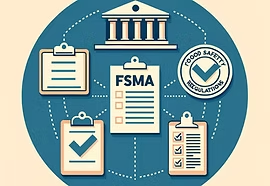
At the heart of FSMA is a simple but demanding requirement — food facilities must identify hazards, put controls in place, monitor those controls, and prove their activity with documentation.
- Establish temperature controls adequate to significantly minimize or prevent pathogen growth and toxin formation.
- Monitor those controls at adequate frequency throughout all operations.
- Take documented corrective action whenever a temperature falls outside established safe ranges.
- Maintain records of all monitoring activity, corrective actions, and verification — retained for a minimum of two years and kept readily available for FDA inspection (offsite records must be retrievable within 24 hours). 21 CFR 117.315
Under FSMA, manual paper logs are not prohibited, but they are increasingly viewed as inadequate. Gaps, missed checks, and retroactive entries are exactly what FDA inspectors look for. Continuous electronic monitoring with timestamped, tamper-evident records is the gold standard. See how Cooler Alert satisfies FSMA ↓
How Cooler Alert Satisfies FSMA Requirements
Cooler Alert’s wireless IoT temperature monitoring system is purpose-built to meet the documentation and control requirements FSMA demands:
Continuous Managed Monitoring
Readings every 5, 10, or 20 minutes across every unit, 24 hours a day, with no manual intervention required.
Instant SMS & Email Alerts
When any unit goes out of your predetermined temperature range, you’re notified immediately so corrective action can be taken and documented.
Tamper-Evident Digital Records
Every reading is timestamped and logged automatically, producing the kind of audit-ready documentation FDA inspectors expect.
Corrective Action Documentation
Log notes and follow-up tasks directly when an anomaly occurs, creating a complete paper trail in one place.
On-Demand Compliance Reports
Generate full temperature histories for any unit, any location, and any time period in minutes, not hours.
Multiple-Location Visibility
Monitor all facilities from a single dashboard, whether you operate one location or twenty.
Who This Applies To
FSMA’s Preventive Controls rule (21 CFR Part 117) applies to food facilities that are required to register with the FDA — those that manufacture, process, pack, or hold human food, including:
- Food manufacturers and processors
- Cold storage and warehouse facilities
- Food distributors
- Co-packers, and central kitchens or commissaries that supply multiple locations
Restaurants, grocery stores, and other retail food establishments are generally exempt from Part 117 registration (see the exemptions in 21 CFR 117.5). Their temperature requirements come instead from the FDA Food Code, enforced by state and local health departments — covered next.
The FDA Food Code: What Governs Restaurants & Retail
While the Preventive Controls rule targets registered facilities, most restaurants, grocers, and food-service operations are held to the FDA Food Code — a model code the FDA maintains and updates that state and local health departments adopt and enforce. Its temperature rules for Time/Temperature Control for Safety (TCS) foods are exactly what an inspector checks on site.
Cold holding — TCS foods held cold must stay at 41°F (5°C) or below (Food Code 3-501.16)
Hot holding — TCS foods held hot must stay at 135°F (57°C) or above (Food Code 3-501.16)
The “danger zone” — the temperature range where pathogens multiply fastest
Cooling (Food Code 3-501.14): cooked TCS food must be cooled from 135°F to 70°F within 2 hours, then from 70°F to 41°F within 4 more hours — a 6-hour window that has to be monitored the whole way.
Cooler Alert’s continuous monitoring documents that your coolers, walk-ins, and holding equipment stay within these limits automatically — producing the timestamped records that back up a clean inspection. The full requirements are published in the FDA Food Code.
Where Cooler Alert Puts FSMA Compliance to Work
Food Service
Walk-ins, reach-ins, freezers, display cases, and holding equipment.
Explore Food Service →Cold Chain
Transit and distribution temperature documentation from origin to destination.
Explore Cold Chain →Healthcare
Food service and nutrition departments within healthcare facilities.
Explore Healthcare →